
Table of Contents
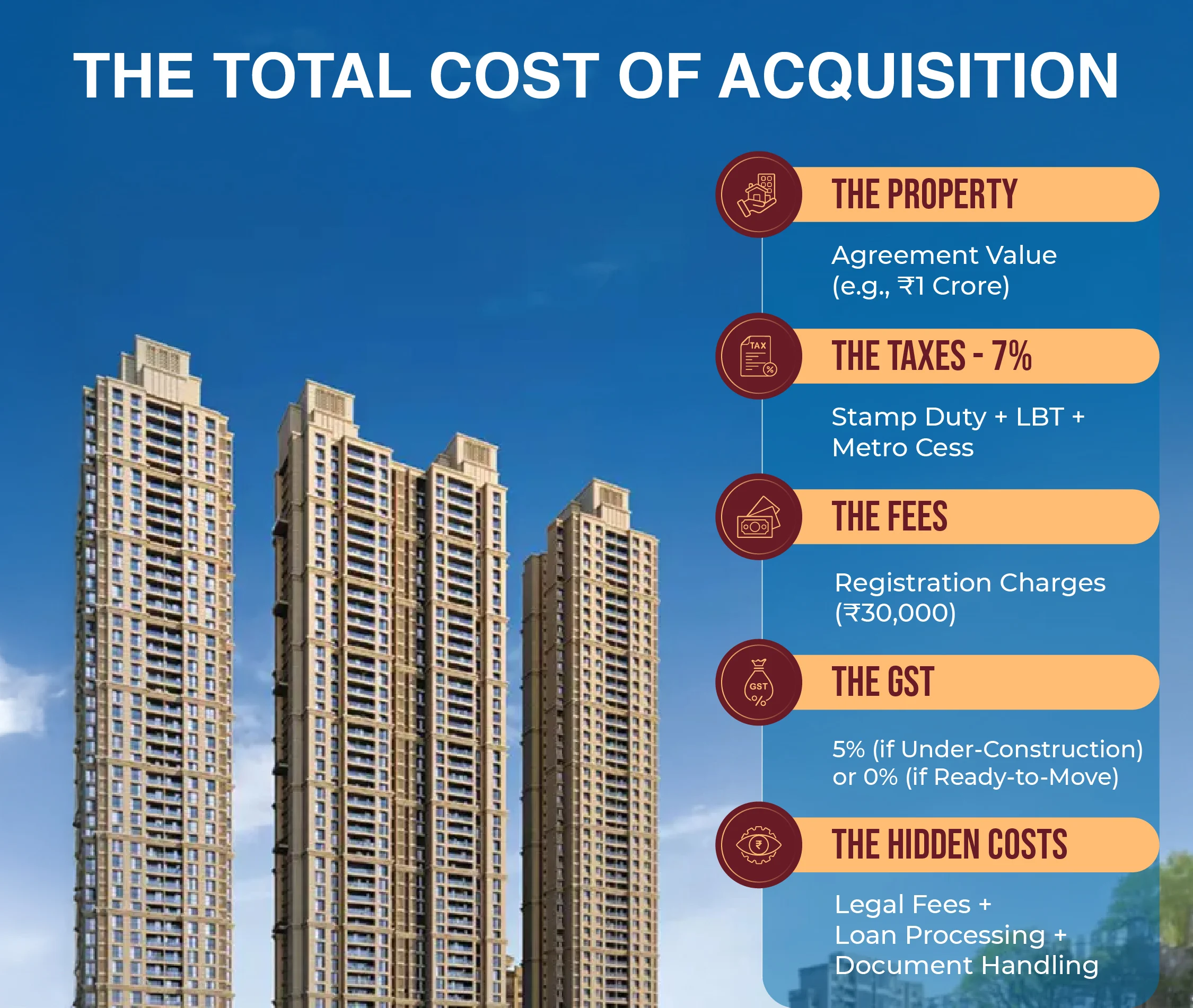
Finding your dream home in the planned city of Navi Mumbai is an exciting journey. Whether you are mesmerized by the panoramic views from luxury projects in Kharghar or the high-yield commercial potential of Nerul, the property price you see on the brochure is never the final price. There is a "hidden" layer of costs that every smart homebuyer must factor into their budget: Stamp Duty and Registration Charges.
In Maharashtra, these charges are not just "fees"; they are mandatory legal taxes that validate your ownership. Ignoring them or miscalculating them can lead to significant budget shocks or, worse, legal complications down the line. At Shreeji Ventures,, we believe in complete transparency. We want you to walk into your new home with zero doubts, zero hidden costs, and total peace of mind.
What Exactly Are You Paying For?
Before we dive into the calculations, it is crucial to understand the legal purpose of these two distinct charges. Many buyers confuse them, but they serve different functions.
1. Stamp Duty
Stamp Duty is a tax levied by the State Government of Maharashtra on the "transaction value" of the property.
- Purpose: It acts as legal evidence of your purchase in a court of law. A document without paid stamp duty is not admissible as evidence.
- Basis: It is calculated based on the market value or the agreement value of the property, whichever is higher.
2. Registration Charges
While Stamp Duty is a tax on the transaction, Registration Charges are a fee paid to the government to officially record your property ownership.
- Purpose: Once registered, your property details are stored in the government’s records (Sub-Registrar’s Office). This protects buyers from fraud and prevents resale of the same property to multiple parties.
- Basis: It is usually a fixed fee or a small percentage of the property value, capped at a certain limit.1
Together, these payments transfer the legal title of the property from the builder or seller to you.
Current Stamp Duty Rates in Navi Mumbai (2025-26)
Navi Mumbai is a unique region. While it is often clubbed with Mumbai, its tax structure is governed by the Navi Mumbai Municipal Corporation (NMMC) and the Panvel Municipal Corporation (PMC).
Currently, the stamp duty structure includes three components:
- Basic Stamp Duty: The primary tax levied by the state government on property transactions.
- Local Body Tax (LBT): A surcharge collected for the municipal corporation.
- Metro Cess: A special infrastructure surcharge introduced to fund major projects such as the Navi Mumbai Metro and the Mumbai Trans Harbour Link (MTHL).
The Gender Advantage
To encourage women's asset ownership, the Maharashtra Government offers a concession. Here is the detailed breakdown:
| Buyer Category | Basic Duty | Local Body Tax (LBT) | Metro Cess | Total Stamp Duty Rate |
|---|---|---|---|---|
| Male | 5% | 1% | 1% | 7% |
| Female | 4% | 1% | 1% | 6% |
| Joint (Male + Female) | 5% | 1% | 1% | 7% |
| Joint (Female + Female) | 4% | 1% | 1% | 6% |
Note on Metro Cess: The 1% Metro Cess was implemented in April 2022.2 It applies to properties in Mumbai, Pune, Thane, and Nagpur regions, which includes Navi Mumbai. This is a direct contribution towards the rapid infrastructure growth you see around you, such as the Kharghar Metro update.
Registration Charges: The Capped Fee
Unlike Stamp Duty, which scales with your property price, the Registration Fee is relatively static.
For Properties > ₹30 Lakhs: A flat fee of ₹30,000.
For Properties < ₹30 Lakhs: 1% of the property value.3
Since most 2 BHK flats in Navi Mumbai and even premium commercial properties in Nerul are priced above ₹30 Lakhs, you should generally budget for the flat ₹30,000 fee.
How to Calculate Your Total Liability (With Examples)
A common misconception is that you pay stamp duty on the price you agreed to pay the seller. That is only partially true. The government calculates stamp duty in Navi Mumbai on the higher of two values:
Agreement Value: The actual price you negotiate and pay the builder/seller.
Ready Reckoner Rate (RRR): The minimum government-defined value of the property for that specific area (e.g., Sector 20, Kharghar).4 The government revises these rates annually (usually on April 1st).
Scenario 1: Agreement Value is Higher (The Ideal Case)
Let’s say you are buying a premium apartment in Shreeji Divine.
- Agreement Value: ₹1.50 Crore
- Ready Reckoner Value: ₹1.30 Crore
- Calculation Base: ₹1.50 Crore (Since it is higher)
- Buyer: Male
- Stamp Duty (7%): ₹10,50,000
- Registration Charges: ₹30,000
- Total Cost: ₹10,80,000
Scenario 2: Ready Reckoner Rate is Higher (The "Tax Trap")
This often happens in resale deals or distressed sales.
- Agreement Value: ₹1.00 Crore (You got a great discount!)
- Ready Reckoner Value: ₹1.10 Crore
- Calculation Base: ₹1.10 Crore (Government ignores your discount)
- Buyer: Male
- Stamp Duty (7%): ₹7,70,000
- Registration Charges: ₹30,000
- Total Cost: ₹8,00,000
Pro Tip: Always check the Ready Reckoner Rate before finalizing a deal. If the gap between your purchase price and the RRR is too wide, it can trigger additional income tax liabilities for both the buyer and seller under Section 43CA and Section 56(2)(x) of the IT Act.
The Woman Homebuyer Concession: Is It Worth It?
As shown in the table, female buyers enjoy a 1% concession on Stamp Duty. While 1% sounds small, on a high-value asset, it is substantial.
Let’s Crunch the Numbers:
If you are buying a 3 BHK flat in Kharghar worth ₹2 Crore:
Male Buyer (7%): Pays ₹14 Lakhs.
Female Buyer (6%): Pays ₹12 Lakhs.
Direct Savings: ₹2 Lakhs!
That ₹2 Lakhs could pay for your modular kitchen or new furniture.
The "Lock-in" Condition
There is a catch to prevent misuse. If you avail of this concession, the woman owner cannot sell the property to a male buyer for at least 15 years.
- If she sells it to a man within 15 years, she will have to pay back the 1% concession plus a heavy penalty to the government.
- However, she can sell it to another woman without penalty.
This makes the concession ideal for end-users who plan to live in the home long-term, rather than investors looking for a quick flip.
Stamp Duty on Other Instruments
While buying a home is the most common transaction, you might encounter other legal documents requiring stamp duty in Navi Mumbai.
1. Gift Deeds
If you want to transfer property within the family (blood relations), the government has made it very affordable.
- Gift to Family (Spouse, Kids, Grandkids, Deceased Son's Wife):Stamp Duty is approx ₹200 + ₹200 Registration fee.
- Gift to Others (Siblings, Friends):3% of the Market Value.
2. Power of Attorney (PoA)
- General PoA: ₹500 (approx).5
- PoA with authority to sell:5% of the market value (treated like a sale).
Total Potential Deduction: A couple can claim a combined deduction of up to ₹7 Lakhs per year (₹3L Principal + ₹4L Interest), provided the actual EMI payments cover that amount.
3. Mortgage/Loan Deposit (MOD)
When you take a home loan, you must deposit the title deeds with the bank. This "Memorandum of Deposit of Title Deeds" attracts a stamp duty of 0.3% of the loan amount (capped at ₹10 Lakhs).
How to Pay Stamp Duty Online: The GRAS System
Gone are the days of buying physical stamp paper from vendors. In Maharashtra, payments for amounts over ₹100 are mandatory via the e-SBTR (Electronic Secure Bank Treasury Receipt) or the GRAS (Government Receipt Accounting System) portal.
Step-by-Step Payment Process
- Visit the Portal: Go to the GRAS Mahakosh website.
- Select Mode: Choose "Pay Without Registration" (unless you already have a login).
- Department Selection: Select "Inspector General of Registration (IGR)".
- Payment Type: Choose "Stamp Duty & Registration Fee".
-
District Selection: Be careful while selecting the district:
- Vashi, Nerul, Belapur: Select Thane
- Kharghar, Panvel: Select Raigad
- Enter Details: Fill in the property details, agreement value, and buyer/seller names.
- Make Payment: Pay using Net Banking, UPI, or generate a challan for bank payment.
- The Challan: Once payment is successful, download the e-Challan and print two copies. This acts as proof of payment and must be submitted at the Sub-Registrar’s office.
The Registration Day: What to Expect?
Paying the duty is step one. Step two is the actual registration at the Sub-Registrar’s Office. Here is what happens on the big day:
- Scheduling: You (or your developer/lawyer) must book a time slot online on the IGR Maharashtra website.
- Attendance: All parties (buyers and sellers) must be present. In case of a developer project, the authorized signatory will attend.
- Witnesses: Two witnesses are required. They must carry their original ID proofs (Aadhaar or PAN).
- Biometrics: Your photograph and thumb impression will be captured digitally.
- Verification: The officer verifies the payment challan and the TDS certificate (mandatory if property value exceeds ₹50 Lakhs).
- Conclusion: Once approved, the document is registered. You usually receive the scanned copy within 30–45 minutes or by the end of the day.
Documents Checklist
- Original Agreement for Sale
- No Objection Certificate (NOC) under RERA
- Latest Property Card / 7/12 Extract
- ID Proofs: Aadhaar Card & PAN Card of all parties
- Passport Size Photographs
- Stamp Duty Payment Receipt (e-Challan)
- TDS Certificate (Form 16B) – if applicable
If you are buying an under-construction flat in Navi Mumbai, the developer’s team usually handles 90% of this logistics.
What If the Deal Is Cancelled? (Refund Policy)
Sometimes, unforeseen circumstances lead to a deal cancellation after you have paid the stamp duty. Do you lose the money? No.
You can claim a refund under Section 47 of the Maharashtra Stamp Act, provided:
- Time Limit: You must apply for the refund within 6 months from the date of the stamp paper or challan.
- Condition: The document must not be executed (not signed by both parties). If it has been signed but not registered, the refund process becomes more complex.
- Deduction: The government usually deducts 1% of the stamp duty amount (minimum ₹200 and maximum ₹1,000) as a processing fee and refunds the balance amount.
Tax Benefits on Stamp Duty
There is a silver lining! The amount you pay as Stamp Duty and Registration Charges is eligible for tax deduction under Section 80C of the Income Tax Act.7
- Limit: Up to ₹1.5 Lakhs (The overall 80C limit includes PPF, LIC, etc.).
- Timing: You can only claim this deduction in the financial year in which the payment was made. You cannot carry it forward.
Why Navi Mumbai vs. Mumbai? A Cost Perspective
One of the reasons homebuyers are flocking to Navi Mumbai is the overall "Cost of Acquisition."
While stamp duty rates are similar (Mumbai is 6% vs Navi Mumbai's 7%), the base property rates in Navi Mumbai are significantly lower.
- South Mumbai: Base Rate ₹50,000/sq.ft + 6% Duty.
- Kharghar: Base Rate ₹10,000-₹14,000/sq.ft + 7% Duty.
The slight 1% difference in duty is negligible compared to the massive savings on the capital value. Furthermore, the infrastructure in nodes like Kharghar offers a quality of life—parks, wide roads, metro—that is hard to find in the congested suburbs of Mumbai.
FAQs: Stamp Duty in Navi Mumbai
Yes. The Metro Cess is a regional infrastructure tax.8 It applies to all property transactions within the municipal limits of Navi Mumbai, Thane, and Panvel, regardless of the immediate proximity to a metro station.
Yes, the GRAS portal allows payment via credit cards.9 However, be aware that banks usually charge a "Merchant Discount Rate" (MDR) or transaction fee for high-value payments via credit card, which can be substantial.10
If you execute (sign) a document but fail to pay the stamp duty on time, a penalty of 2% per month on the deficit amount is levied, up to a maximum of 400% of the duty amount. It is always safer to pay before signing.
Yes. The "Agreement Value" includes the total consideration paid for the property, including floor rise, preferential location charges (PLC), and clubhouse membership fees. Stamp duty is calculated on this total bundled cost.
Franking (where a bank stamps your document) is still available but has a limit (usually up to ₹5,000 stamp duty). For property transactions involving lakhs of rupees, the e-Payment/GRAS method is mandatory and much more secure.
Conclusion: Plan, Calculate, Invest
Paying stamp duty in Navi Mumbai is the final step in securing your legal rights to your home. While it is a significant cost—often running into lakhs—it validates your hard-earned investment. By planning for it in advance, understanding the "Ready Reckoner" traps, and utilizing concessions like the female ownership benefit, you can optimize your outflow.
At Shreeji Ventures, we build more than just apartments; we build trust. Our sales team is equipped to help you estimate your "all-inclusive" price—including taxes, GST, and duties—so you never face a budget shock.
Connect With Us
- YouTube: Shreeji Ventures
- Instagram: @shreeji_ventures_official