
Table of Contents
Buying a home is often the biggest financial decision of your life. Whether you are eyeing luxury projects in Kharghar or a smart investment in Nerul, the initial sticker price can feel overwhelming. However, the Indian government offers a silver lining in the form of home loan tax benefits, which can significantly reduce the effective cost of your home.
For many, a home loan is just a debt obligation. But for the financially savvy, it is a powerful tax-saving tool. In fact, with the right planning, a home loan can help you save lakhs in taxes every year, essentially subsidizing your purchase.
At Shreeji Ventures, we believe in empowering our homebuyers not just with keys to a new home, but with the financial wisdom to manage it. In this guide, we will decode the complex world of tax sections, exemption limits, and joint home loan tax benefits, helping you make the most of your investment in Navi Mumbai.
Why a Home Loan is Your Best Tax-Saving Friend
When you take a home loan, you repay it in Equated Monthly Installments (EMIs). Each EMI has two components:
- Principal Amount: The actual loan amount you borrowed.
- Interest Amount: The cost of borrowing the money.
The Income Tax Act of India treats these two components differently, offering separate deductions for each. This means you can reduce your taxable income by claiming these amounts, thereby lowering the total tax you pay to the government.
Let's break down the specific sections that govern these benefits.
Section 80C: The Home Loan Principal Tax Benefit Section
This is the most popular deduction section, but many forget that their home loan principal falls under it.
What is Covered?
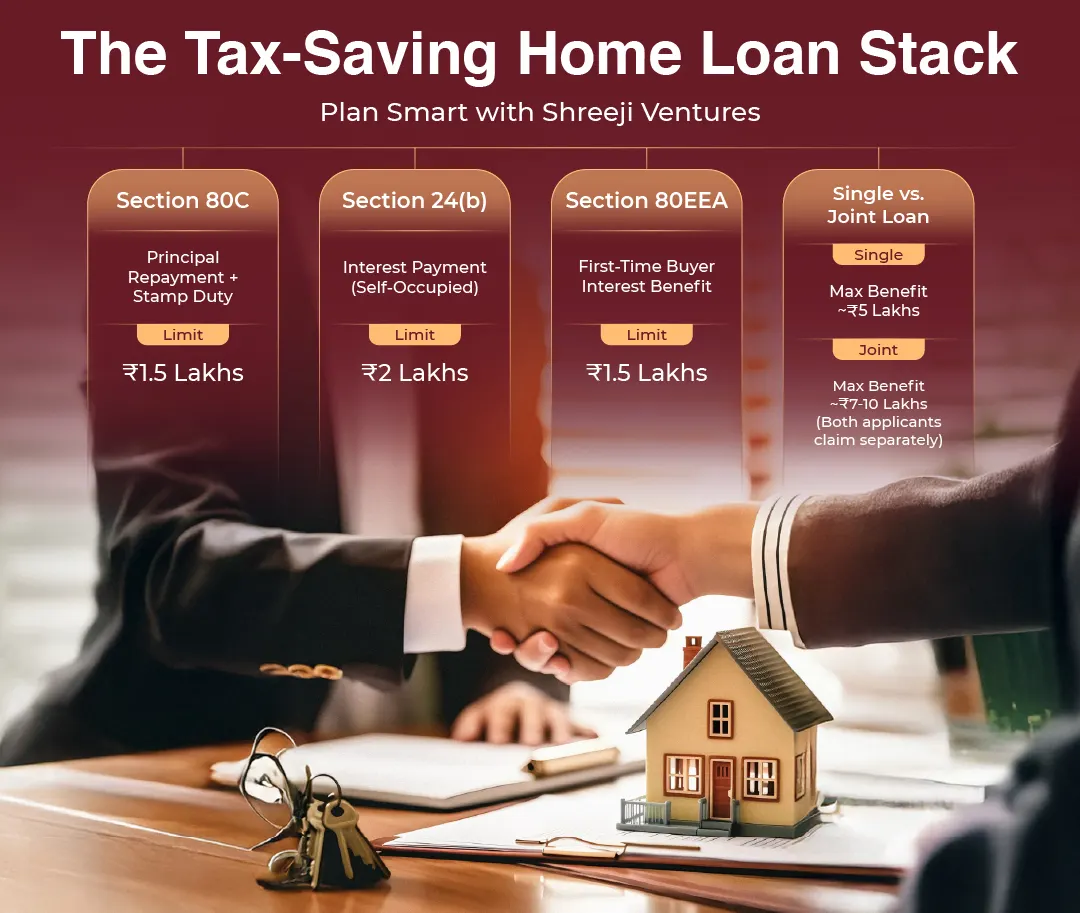
The home loan principal tax benefit section (Section 80C) allows you to claim a deduction for the principal component of your EMI.
- Maximum Limit:₹1.5 Lakh per financial year.
- Condition:The property must not be sold within 5 years of possession. If you sell it earlier, the tax deductions claimed in previous years will be added back to your income and taxed.
- Stamp Duty Bonus:Did you know? The amount you pay for stamp duty and registration fees is also eligible for deduction under Section 80C. This is a massive benefit for the year you purchase your property.
Pro Tip: If you have bought a property recently, check our guide on Stamp Duty and Registration Charges in Navi Mumbai to understand how much you can claim.
Section 24(b): The Home Loan Interest Tax Benefit Section
While Section 80C is crowded with other investments (like PPF, LIC), Section 24(b) is dedicated almost exclusively to homeowners.
Self-Occupied Property
If you live in the house you bought (or your family does), it is considered self-occupied.
- Maximum Limit: You can claim a deduction of up to ₹2 Lakhs per financial year on the interest paid.
- Condition: The construction/purchase must be completed within 5 years from the end of the financial year in which the loan was taken. If delayed, the limit drops to just ₹30,000.
Let-Out (Rented) Property
If you have rented out your property—perhaps one of our commercial properties in Nerul—the rules are different.
- Maximum Limit: There is no upper limit on the interest amount you can claim as a deduction.
- The Catch: While you can deduct the full interest from your rental income, if this calculation results in a loss (i.e., Interest > Rent), you can only set off a maximum loss of ₹2 Lakhs against your other income (like salary) in the same year. The remaining loss can be carried forward for 8 years.
Extra Savings for First-Time Buyers (Section 80EE & 80EEA)
To boost the "Housing for All" initiative, the government introduced additional sections for affordable housing. These are over and above the ₹2 Lakh limit of Section 24(b).
Section 80EEA
Who is it for? First-time homebuyers.
Benefit: Additional deduction of up to ₹1.5 Lakhs on interest.
Criteria:
- Stamp duty value of the property must be ≤ ₹45 Lakhs.
- Loan sanctioned between April 1, 2019, and March 31, 2022
- You should not own any other house on the date of loan sanction.
(Note: While the sanction window for this has technically closed, many buyers paying off loans from that period are still eligible for this deduction annually until repayment).s
Joint Home Loan Tax Benefits: Double the Savings
This is where smart family planning meets financial planning. If you take a joint home loan with your spouse, parent, or sibling, and you are both co-owners of the property, your tax benefits can double.
How it Works
Each co-borrower who is also a co-owner can claim the deductions individually in their respective Income Tax Returns.
- Principal (Sec 80C):Both can claim up to ₹1.5 Lakhs each. (Total: ₹3 Lakhs)
- nterest (Sec 24b):Both can claim up to ₹2 Lakhs each. (Total: ₹4 Lakhs).
The New Tax Regime (Default)
- Does NOT allow: Section 80C deductions.
- Does NOT allow:Section 24(b) deductions for self-occupied properties.
- Exception:You CAN claim interest deduction for a let-out (rented) property, but only up to the extent of the rental income (you cannot set off losses against your salary).
Total Potential Deduction: A couple can claim a combined deduction of up to ₹7 Lakhs per year (₹3L Principal + ₹4L Interest), provided the actual EMI payments cover that amount.
Example:
If Mr. and Mrs. Saad buy a 3 BHK flat in Navi Mumbai and pay an annual interest of ₹3.8 Lakhs, a single applicant could only claim ₹2 Lakhs. However, as joint applicants, they can claim the full ₹3.8 Lakhs (₹1.9 Lakhs each), saving significantly more tax.
Old Regime vs. New Tax Regime: Which is Better for Home Loans?
SWith the introduction of the New Tax Regime, confusion has increased. Here is the simple truth regarding home loan tax exemption limits:
The Old Tax Regime.
- Allows:Section 80C (Principal) deduction.
- Allows:Section 24(b) (Interest) deduction for self-occupied properties.
- Best for:People with significant deductions (Home Loan, HRA, Insurance) who want to lower their taxable income aggressively.
The New Tax Regime (Default)
- Does NOT allow: Section 80C deductions.
- Does NOT allow:Section 24(b) deductions for self-occupied properties.
- Exception:You CAN claim interest deduction for a let-out (rented) property, but only up to the extent of the rental income (you cannot set off losses against your salary).
Verdict: If you have a home loan, staying in the Old Tax Regime is often more beneficial. We recommend consulting a CA to calculate your specific liability.
Using a Home Loan and Tax Benefit Calculator
Before you rush to file your taxes, it is wise to use a home loan and tax benefit calculator. These online tools help you estimate your savings.
How to Calculate manually:
- Step 1:Check your Home Loan Provisional Certificate (available from your bank).
- Step 2:Identify the total Principal paid and Interest paid for the financial year.
- Step 3:Apply Principal to Sec 80C (Max ₹1.5L),Apply Interest to Sec 24(b) (Max ₹2L for Self-Occupied).
- Step 4:Subtract these amounts from your Gross Taxable Income.
- Step 5:Calculate tax on the remaining amount based on your slab.
Pre-Construction Interest: Don't Lose Money
Many buyers of under-construction flats in Navi Mumbai worry about the interest they pay while the building is being constructed.
Good News: You don't lose this money.
The interest paid during the pre-construction phase can be claimed in 5 equal installments starting from the year you get possession. This is claimed under Section 24(b), subject to the overall limit of ₹2 Lakhs per year.
FAQ: Vastu Shastra for Home Plan
Yes. For a second home (if not self-occupied), you can claim the full interest paid as a deduction against the rental income. However, the loss set-off against other income is capped at ₹2 Lakhs.
For self-occupied homes, it is ₹2 Lakhs for interest (Sec 24b) and ₹1.5 Lakhs for principal (Sec 80C).
Yes! If you live in a rented house (in a different city or due to work reasons) and own a home elsewhere, you can claim both HRA exemption and Home Loan deductions.
Yes, under Section 80C, but only in the year the payment is made.
The tax benefits claimed under Section 80C (Principal) will be reversed and treated as income in the year of sale.
Conclusion: Plan Your Home, Plan Your Taxes
A home loan is a long-term commitment, but the home loan tax benefits turn it into a high-return investment. By understanding these sections, you can significantly reduce the burden of your EMIs.
At Shreeji Ventures, we offer more than just homes; we offer lifestyle solutions in the heart of Navi Mumbai. From Vastu-compliant layouts to investment-grade assets, our projects are designed to maximize your value—both in lifestyle and finance.
Ready to make a smart investment?
Explore our Residential Projects or Commercial Spaces today.
Need help deciding?
Contact Us for a consultation on the best properties in Kharghar and Nerul.
Connect With Us
- YouTube: Shreeji Ventures
- Instagram: @shreeji_ventures_official