
Table of Contents
If you imagine your business in a time capsule set 5 or 10 years from now, what do you want it to look like? Robust, growing, profitable, easy to access, hard to knock down (figuratively)? That is what future proofing means. Buying or leasing an under construction commercial property in a place like Nerul is like planting a sapling today so that tomorrow you have shade, fruit, and maybe even a tree house. This article explains why Nerul is a strong bet, what to look for, and how to make sure your investment or space works as well in ten years as it does the day you start.
Why Nerul? The Ground You Want Under Your Feet
Before you go hammer and nail, you want a good foundation. Nerul offers that. Here are reasons why this node in Navi Mumbai is drawing business eyes.
Strategic Connectivity
- Nerul has good transport links by road and rail. It is connected via Palm Beach Road, local train stations, and proximity to other growing hubs in Navi Mumbai.
- Planned infrastructure growth in and around Nerul promises improved connectivity, making movement of people (customers, staff) and goods easier.
Rising Land Costs Signal Demand
- Plots in Nerul are fetching record bids in recent times. That suggests strong demand and that the market believes this area is going to be more valuable.
- When prices for land or tender plots go up, people building or buying early often get better “upside” if the work is completed and the area matures.
Growing Commercial Appeal
- As Mumbai becomes more congested and expensive, Navi Mumbai and Nerul especially has become an attractive alternative for offices, retail spaces, showrooms, small tech parks.
- Businesses want lower costs, good lifestyle, less traffic stress, but still access to the city and other business nodes. Nerul ticks many of those boxes.
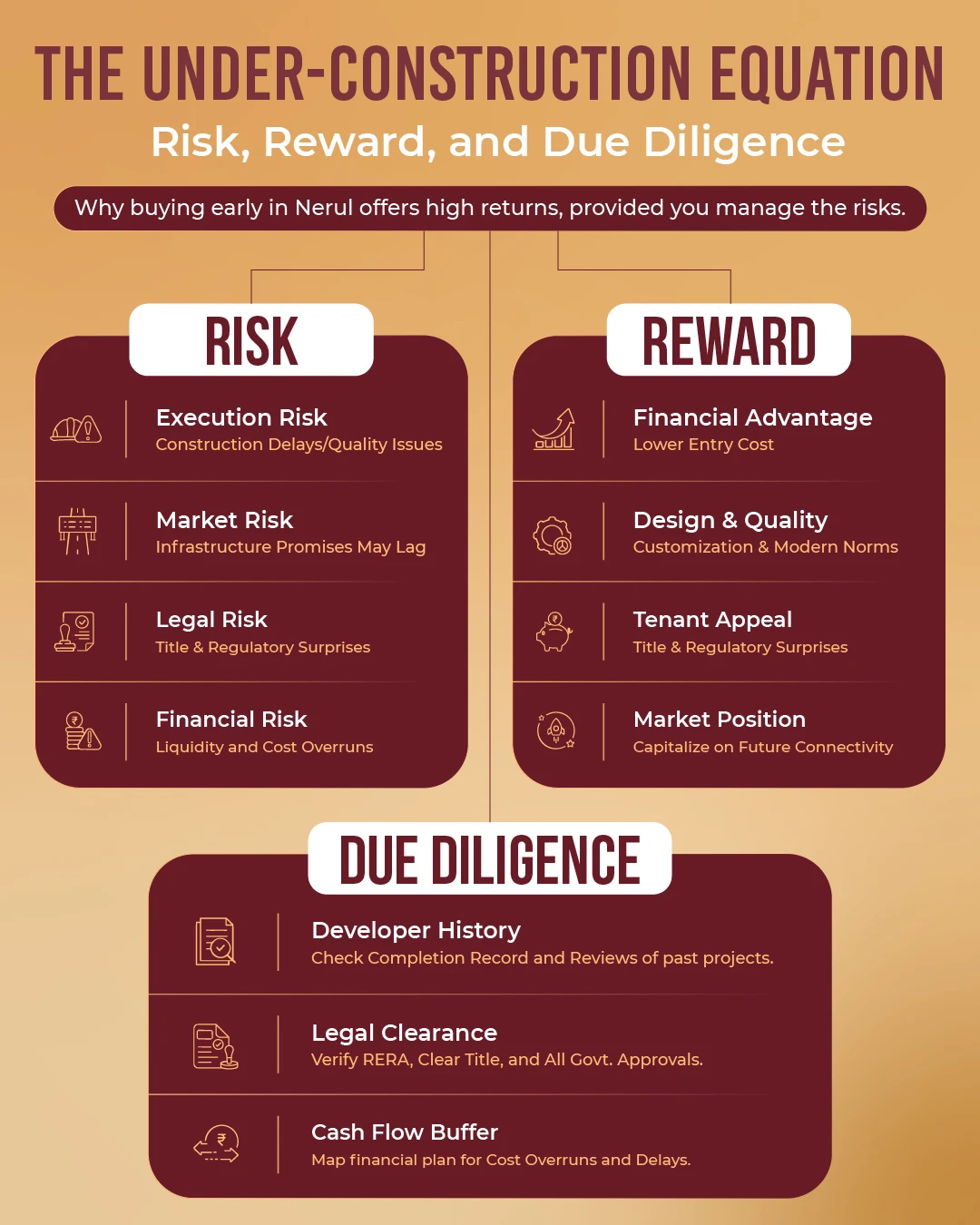
Benefits of Under Construction, Not Ready‐Made
Now, why would you choose something that’s under construction instead of “move in tomorrow”? Because with risk also comes reward.
Lower Initial Cost, Higher Potential Gain
- Under construction spaces are usually cheaper per square foot than ready‐to‐move ones. You pay more for “what is” than for “what will be.” If you jump early you catch the “will be” before everybody else.
- Capital appreciation tends to be higher in such properties once construction finishes and infrastructure catches up.
Customisation and Contemporary Design
- When the building is still being built, you often get better chance to influence layout, interiors, utilities. You might pick office floor height, electrical load, common area designs.
- Newer buildings often follow newer norms (earthquake safety, green building codes, energy efficiency). That means less retrofitting later, which saves headaches and money.
Better Long Term Rental Yield and Tenant Stickiness
- Tenants often prefer modern amenities: elevators, parking, safety, climate control. If your building offers these, you can command higher rent.
- Longer leases are easier to secure in newer, well managed commercial spaces. Companies want continuity; they avoid moving every few years if the infrastructure is reliable.
Risks and How to Hedge Them: Not All That Glitters Is Built Yet
Under construction is not risk free. Future proofing means anticipating risks and preparing. Think of it as wearing boots while walking in mud.
Construction Delays and Quality Issues
- Developers miss deadlines. Materials cost rise. Labour issues pop up. All delay your occupancy or your return on investment.
- Quality may differ from what was promised: finishes, utilities, or even safety systems.
Hedge: Do your due diligence. Check the reputation of the developer. Ask for timelines with penalties. Seek references from earlier projects. Build in buffer time in your plan.
Infrastructure Promises Vs Reality
- Even if a road, metro link or airport is “proposed” or “in planning”, it may come late or be scaled down. If your business counts on that, you could be hurt.
- Utilities (water supply, power, internet connectivity) may lag behind.
Hedge: Check official status of infrastructure projects. Visit local government / CIDCO / NMMC websites, current tender documents. Speak to nearby existing businesses. If possible have backup plans (alternate routes, backup power, etc.).
Liquidity and Market Fluctuations
- If you buy (rather than lease), resale may be tricky if market slows. Sometimes price appreciation does not match expectations.
- Demand for commercial space depends on economic factors; tenant demand, interest rates, business growth. These can swing.
Hedge: Keep your investment scale manageable. Don’t over‐borrow. Consider lease options. Have exit criteria. Spread risk (e.g. smaller unit sizes, diversified tenants).
What Makes a Good Under Construction Commercial Property in Nerul
Let us get down to checklist mode: what features and factors make a property “future proof” in Nerul.
| Feature | Why It Matters |
|---|---|
| Location within Nerul | Closeness to train stations, major roads, Palm Beach Road, future highways or metro stations matters. The nearer the better. |
| Reputation of Developer / Builder | Someone who has delivered on time, uses good quality materials, follows compliance, uses green/best practices. |
| Modern Amenities | Parking, power backup, security, fire safety, elevators, internet infrastructure. These are expected in future so you need them now. |
| Flexible Space Design | Column spacing, ceiling height, floor layout that allows flexibility for different tenant types. |
| Compliance with Regulations | Zoning, floor space ratio (FSI), building permissions, environmental regulations, evacuation norms. Ensures no surprises. |
| Long Term Maintenance Plan | How common areas will be maintained, how management will run. Even if the building is new, bad maintenance kills value. |
| Clear Title and Legal Clarity | Ownership issues, land title, developer legal history, approvals. You want your rights secure. |
| Infrastructure Support | Roads, water, sewage, power grid, internet, public transport. Even good buildings are useless if electricity fails or roads are bad. |
| Cost of Ownership Beyond Price | Taxes, maintenance, utilities, parking charges, common area maintenance. These recurring costs might grow and eat into profit or cash flow. |
Realities in Nerul Right Now
Using what is known from recent property / real estate data, here are practical observations in the Nerul commercial space scene.
Strong Price Trends
- Average property rates in Nerul are fairly high compared to many Navi Mumbai nodes. It has been rising steadily.
- Tender plots in Nerul (especially those near major roads or Palm Beach Road) have sold at record per square meter rates, which signals very strong demand.
Increasing Commercial Projects
- Several upcoming commercial developments are being planned in Nerul or near it. For example the “Top 15 Upcoming Commercial Projects in Navi Mumbai for 2025” includes Grade A office spaces in Nerul.
- Projects like Tescon Plan I Business Park (in Nerul) with office/shop space are under construction. That means competition, but also validation that the area is good for business.
Demand Side
- There is demand from startups, corporate offices, small and medium firms for commercial space in Navi Mumbai because of lower costs compared to Mumbai proper
- Tenants are looking for newer standards: reliable power, parking, safety, modern amenities. Old commercial stock often lacks in these; under construction is able to offer them.
How to Calculate If It’s a Smart Investment
Here are some numbers and thought experiments to run before you commit. Think of them as your business’s workout routine.
Estimate Total Cost vs Expected Returns
- Add up cost of purchase or lease, plus fit‐out cost (interiors, utilities, furniture), plus recurring costs (maintenance, power, taxes).
- Estimate your income: rental income or savings versus leasing alternatives. If you are using for own business, what value do you assign to convenience, image, etc.
- Compare to alternative real estate options: ready property, cheaper nodes, or even Mumbai fringe.
Time Value: When Will It Be Usable?
- If completion is 3 years away, discount what that means for your cash flow. You might need to pay sooner but use later. The delay cost is real.
- Also, what is the rate of infrastructure build out (roads, public transport)? Sometimes the building is ready but roads remain a mess or plumbing remains problematic.
Risk Adjusted Returns
- Factor in possibility: delays, cost overruns, regulatory changes. Make best case / worst case scenarios. If worst case still acceptable, go ahead.
- Also consider tenant risks: what kind of business may occupy your space? If the economy redoes, what kinds of tenants survive? Retail is riskier than office in some conditions; IT/ITES more stable maybe.
Checklist Before You Sign the Deal
Think of this as the “hard hat list” you keep handy before you shake hands with the developer. Each point here can save you from the kind of surprises that make business owners groan years later.
-
Developer History
A builder’s past work is the best crystal ball you will ever get. Check the track record of completed projects. Did they hand over properties when promised or do their deadlines slide like wet tiles in the monsoon. Look for reviews from previous buyers and tenants. If most of them are still fuming about leakages or endless delays, treat that as a red flag. Reliable developers in Navi Mumbai usually have a steady pipeline of projects, certifications from local authorities and a reputation for finishing what they start.
-
Legal Checks
Never sign anything before the paperwork passes the “sleep easy” test. Ensure the land title is clear and undisputed. Ask for all government approvals such as building permissions, commencement certificates and environmental clearances. Make sure the land is free of encroachment and the developer has paid any dues to local bodies. If you are not a legal expert, bring in a property lawyer. A few hours of their time costs less than years of courtroom stress later.
-
Infrastructure Maps
Promises of glittering highways and metro links look great on brochures but you need to see what actually exists on the ground. Study the official infrastructure plans from city authorities. Check whether the proposed roads and transport links are under construction or just in the talking stage. Confirm that utilities such as water supply, power connections and internet services are already planned for the building. Walk around the site to see current access roads and public transport stops. Your customers and staff will thank you when they do not have to wade through traffic chaos or potholes.
-
Detailed Timelines
Ask for a written schedule that covers every milestone from laying the last brick to installing the lift. A vague “possession in two years” is not enough. Good developers break down timelines for structure completion, interior work and handover of amenities such as parking and security systems. Check for penalty clauses if the builder misses deadlines. A clear timeline is not just a piece of paper; it is your bargaining chip if delays occur.
-
Financial Cash Flow
Before you sign, sharpen your pencil and map your money. Calculate how you will fund the purchase or lease and what happens if construction drags on. Add a buffer for cost overruns cement prices and labour costs have a habit of rising at the worst time. If you plan to borrow, compare interest rates from banks and understand how rate changes could affect your monthly outgo. A solid funding plan keeps your business safe from surprise cash crunches.
-
Lease and Rental Market
If you plan to rent out the property, study who your future tenants might be and what they are willing to pay. Visit nearby commercial spaces of similar size and check their rental rates. Find out what amenities tenants expect—ample parking, strong internet connectivity, backup power. Understanding the local rental market helps you set realistic income goals and ensures you are not left with a fancy empty space and no takers.
-
Exit Plan
Even the best business plans can change direction. Maybe you outgrow the space, maybe your industry shifts. Think ahead about how easy it will be to sell or repurpose the property. Look for flexible layouts that can serve multiple uses—office today, co-working space tomorrow, showroom next year. Check historical resale values in the area to see how well properties appreciate. An exit plan is like a spare tyre; you hope you will not need it but you will be glad it is there.
-
Long Term Maintenance
A sparkling new building can age quickly if maintenance is an afterthought. Find out what the common area maintenance (CAM) charges will be and what they cover—security, cleaning, landscaping, elevator service. Ask who manages the property once construction is complete. A strong management system keeps shared spaces functional and attractive, which in turn protects your property value. A low purchase price can turn costly if maintenance is poor or CAM fees keep climbing every year.
Future Proof Features to Demand
When you are inspecting or finalizing design, these features can help you stay ahead:
- High ceiling height and open floor plates so future tenant layouts can change without rebuilding walls.
- Ample parking, including for two‐wheelers, cars, maybe even electric vehicles. EV charging points are getting more relevant.
- Reliable backup power to avoid downtime costs.
- Strong internet and telecom connectivity. Redundancy helps (multiple providers).
- Smart infrastructure: energy efficiency (LEDs, insulation), water recycling, slope drainage (for rains).
- Safety measures: fire escape, CCTV, security, sanitation.
- Flexibility: space that can serve as retail, showroom, office, co‐working. Mixed use helps if you want to pivot.
How to Finance Wisely
Good idea to think about money flow. How are you paying, how are returns coming, what are risks if costs go up.
- Pre‐launch or early booking advantages often give discounts or better payment plans. But ensure those are backed by builder guarantee.
- Consider leasing rather than buying if you want flexibility or uncertain future business size.
- Use phased investment: maybe start with a smaller property, expand later. Don't bite off more than you can chew.
- Get professional advice: real estate lawyer, chartered accountant, maybe a property consultant. It pays vs mistakes.
What the Future Might Look Like (If You Do It Right)
If you pick a good under‐construction commercial property in Nerul and follow the checklist, here is what your business might enjoy 5-10 years down the line:
- Your commercial space is well connected; staff commute is easier; customers find you without complaints.
- Maintenance is smooth; amenities still working; building not looking old or shabby.
- Rental yield or business savings from owning good space gives you cash to reinvest.
- Flexibility to adapt: maybe part of your office becomes showroom, maybe a café opens in ground floor retail, maybe co-working.
- Building value has appreciated substantially. If you want to sell, you can do so with a good profit margin.
Conclusion: Planting Trees that Bear Fruit
Future proofing is not about perfection. It is about being smart about what you can control while preparing for what you can’t. Under construction commercial property in Nerul has promise. It has the bones: connectivity, rising demand, premium buyer interest, ever increasing land values. But the flesh (construction, maintenance, infrastructure delivery) must hold up.
If you plant today, water regularly, guard against storms, chances are you’ll sit under a spacious canopy in years to come. Or better: your business will.